What Is Othello Parity? Counting Squares and Winning the Last Move
Published
Conclusion: Othello parity is the endgame strategy of counting empty squares in each distinct region: play first into odd regions and force your opponent into even regions so that you play the last move in every region. However, since the outcome in the same odd region changes depending on which square you enter, you must confirm with reading.
Once you master the basic rules of Reversi (Othello) and learn how to manage discs in the midgame, you might find yourself struggling to maximize discs in the endgame. A vital concept that decides victories in the endgame is Othello parity. Understanding this mechanic will help you find winning lines calmly on your smartphone.
| Item | Parity Rule |
|---|---|
| When to use | Endgame (when empty squares divide into regions) |
| Odd region | Play first yourself |
| Even region | Wait for your opponent to play first |
| Why it fails | Turn order shifts due to a pass or running out of moves |
| Practice in app | Offline computer matches in Patent War; undo 3 times per game |
Parity Basics: Odd and Even Regions
In Othello, parity is an endgame tactic where you count the empty squares divided into isolated regions and plan your moves so that you play the final move in each region. Because you are the last player to flip discs in that region, you can greatly increase your disc count.
When a region has an even number of empty squares, your opponent entering first allows you to take the last move. Conversely, if your opponent plays into an odd region first, they will secure the final move. The player who makes the last move often turns discs in that region into stable discs, creating a huge surge in score.
- Odd region (1 square, 3 squares, etc.): Enter first yourself and aim to claim the final move in that region.
- Even region (2 squares, 4 squares, etc.): Do not enter yourself; let your opponent play first so you take the final move.
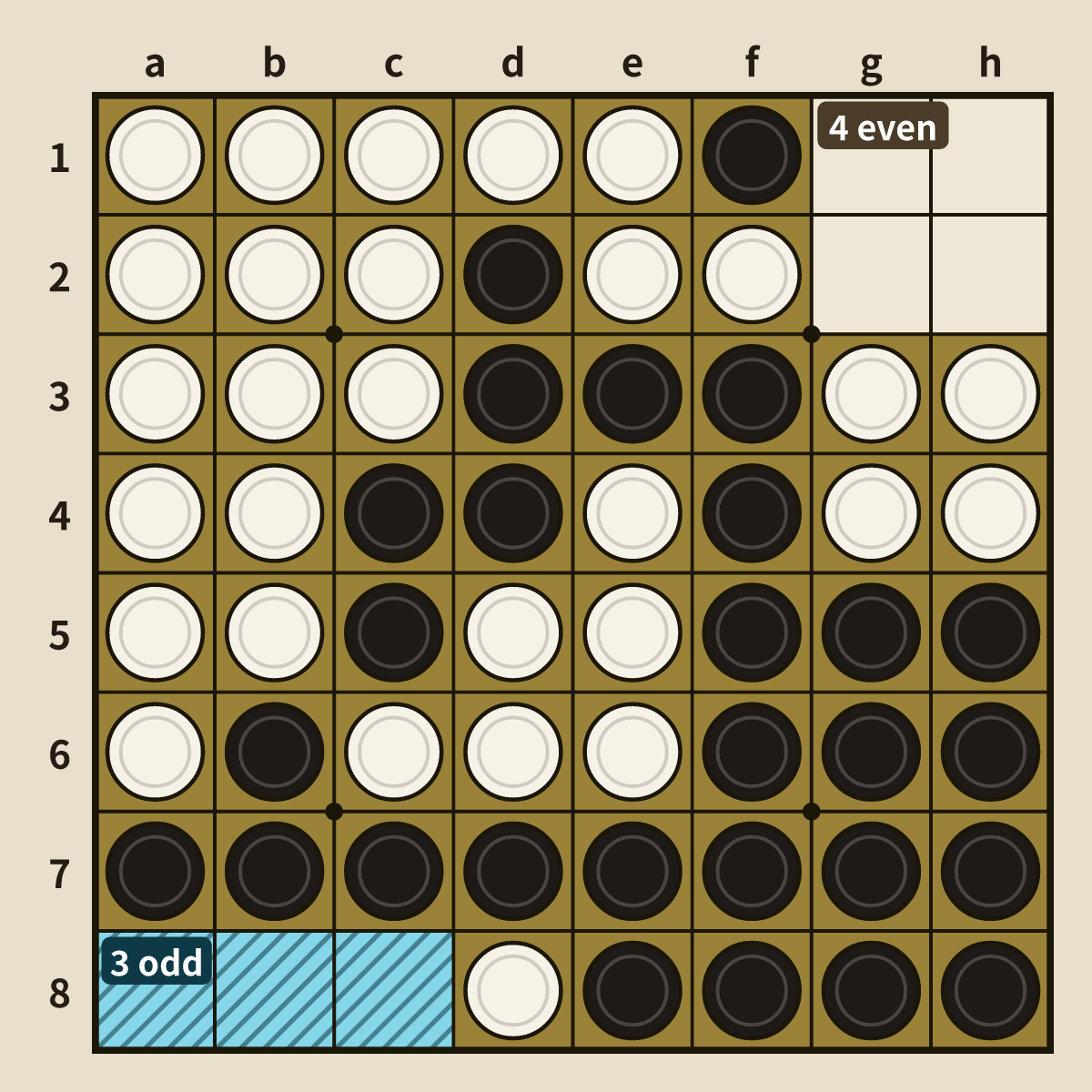
Figure 1 as text
Black discs (28): f1 d2 d3 e3 f3 c4 d4 f4 c5 f5 g5 h5 b6 f6 g6 h6 a7 b7 c7 d7 e7 f7 g7 h7 e8 f8 g8 h8
White discs (29): a1 b1 c1 d1 e1 a2 b2 c2 e2 f2 a3 b3 c3 g3 h3 a4 b4 e4 g4 h4 a5 b5 d5 e5 a6 c6 d6 e6 d8
To move: White
Empty regions: a8 b8 c8 (3 squares, odd), g1 h1 g2 h2 (4 squares, even)
Board (from rank 1): WWWWWB../WWWBWW../WWWBBBWW/WWBBWBWW/WWBWWBBB/WBWWWBBB/BBBBBBBB/...WBBBB
In this board, the remaining empty squares are split into two areas: a 3-square odd region at a8, b8, and c8, and a 4-square even region at g1, h1, g2, and h2. By playing into the odd region, White makes it easier to secure the final move in that sector.
Midgame Preparation and the Role of Book Openings
To use parity effectively in the endgame, your play up to the midgame is crucial. Standard book openings like Rabbit, Tiger, and Cow all aim to minimize flipped discs during the opening phase and midgame, thereby reducing the opponent's available squares.
Preserving many options for yourself prevents you from being forced into even regions during the endgame. In addition, avoiding careless moves to an X-square or C-square and denying your opponent corner access are vital steps to maintaining endgame initiative.
Play in the app
The quickest way to learn an idea is to try it on the board. Your computer opponent thinks right on your device, so you can play every game against it to the end, anytime and anywhere.


Scan with your phone to open the store
Parity Steps: Success and Common Beginner Mistakes
The procedure for parity has 3 steps: 1. Count empty squares by region, 2. Find legal moves in odd regions, and 3. Avoid entering even regions first. In a position with Black to move and 3 empty squares (a1, b1, d1), playing into the 1-square odd region d1 succeeds; no matter whether White responds on a1 or b1, Black wins (even against White's best defense, Black wins 36 to 28). A common beginner mistake is entering the 2-square even region b1 first. After White plays d1, Black has no moves and must pass, allowing White to play a1 as well, leading to a 29 to 35 loss for Black.
Figure 2 as text
Black discs (31): e1 f1 g1 h1 a2 b2 e2 f2 g2 a3 b3 d3 f3 a4 h4 a5 d5 g5 h5 a6 b6 f6 g6 h6 a7 b7 g7 h7 a8 g8 h8
White discs (30): c1 c2 d2 h2 c3 e3 g3 h3 b4 c4 d4 e4 f4 g4 b5 c5 e5 f5 c6 d6 e6 c7 d7 e7 f7 b8 c8 d8 e8 f8
To move: Black
Empty regions: d1 (1 squares, odd), a1 b1 (2 squares, even)
Board (from rank 1): ..W.BBBB/BBWWBBBW/BBWBWBWW/BWWWWWWB/BWWBWWBB/BBWWWBBB/BBWWWWBB/BWWWWWBB
| Region State | Decision | Aim / Result |
|---|---|---|
| Odd region | Play first yourself | Give opponent an even region and play the last move |
| Even region | Do not play first | Let opponent play first and play the last move |
| Success (Black, 3 empties) | Play d1 in the odd region | Black wins 36 to 28 |
| Mistake (Black, 3 empties) | Enter b1 in the even region | Black passes and loses 29 to 35 |
| Mistake (White, 7 empties) | Enter c8 in the odd region | White loses 30 to 34 (wins 33 to 31 with corner a8) |
Disrupting Opponent Parity: Running Out of Moves and Passing
Defending against parity means shifting the turn order by 1 move through passing or exhausting legal moves when your opponent is set to take the last move. If you preserve quiet squares where only you can play, you can insert 1 move whenever you like and flip the odd and even sequence. This matches how the order shifted when Black passed in the mistake above. See Solving Othello Endgame Puzzles for endgame reading and Othello Openness and Quiet Moves for quiet moves.
Try this sequence in offline computer matches in Patent War. The AI calculates on-device, letting you play anywhere without signal, with up to 3 undos per match. After the match, review each move in the Logbook and use Analyze Game to check optimal moves and critical turning points.
Frequently asked questions
What is parity?
It is an endgame strategy to ensure you play the final move in separate empty regions. Making the last move secures stable discs and boosts your score.
Why should I not enter an even region first?
If you play into an even region first, your opponent gets the last move. Letting them enter first gives you the final move in that region.
What causes parity to break down?
Losing mobility in the midgame forces you into unwanted even regions. Restrict disc flipping early on to preserve your future options.
Can I practice parity in the Reversi app Patent War?
Yes, offline matches against the on-device AI and reviews are free. Play without signal, use up to 3 undos, and replay moves in the Logbook.
Play in the app
Patent War is a steampunk-themed Reversi app. Embark on your journey and play against AI for free.
Scan with your phone to open the store