How to Solve Endgame Puzzles and Read Moves Through the Endgame in Reversi
Published

Many players successfully gain an advantage during the midgame in Reversi, only to suffer a comeback loss in the endgame phase. Practicing with endgame puzzles—reading every move accurately until the end of the game—is an effective way to overcome this. In an endgame situation, you need the ability to calculate guaranteed legal moves and the gain or loss of discs logically, rather than relying on intuition.
Basic Steps for Solving Endgame Puzzles
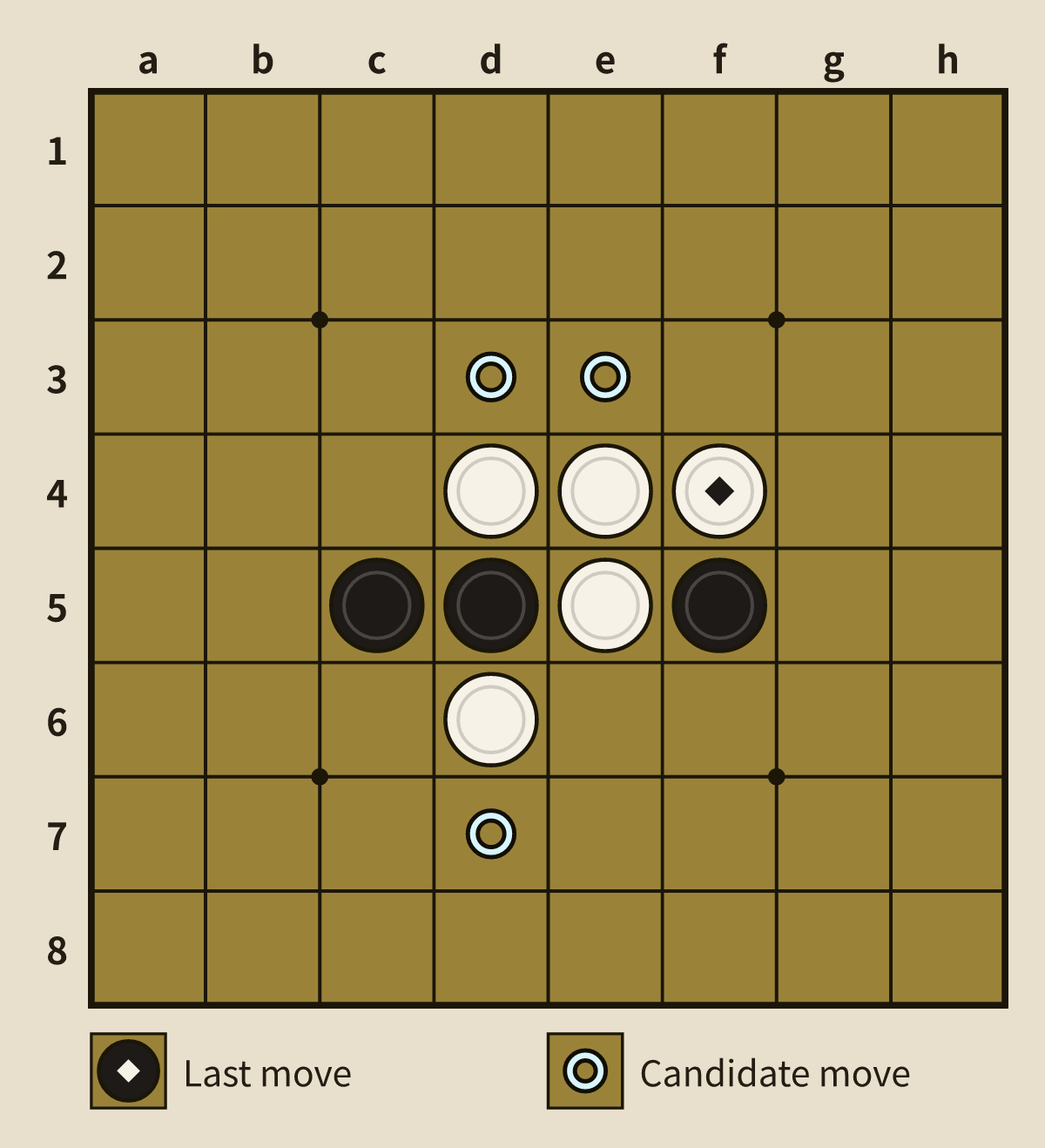
Figure 1 as text
Black discs (3): c5 d5 f5
White discs (5): d4 e4 f4 e5 d6
To move: Black
Last move: f4
Candidate moves: d3 d7 e3
Board (from rank 1): ......../......../......../...WWW../..BBWB../...W..../......../........
This diagram shows the position right after playing f4 (focus on d3, d7, and e3).
In this diagram, Black has multiple squares to play on this turn. Beginners often look for a move that flips many discs at once, but reading through the endgame requires determining where the opponent will play next. Observe how the opponent's available squares change after you make a candidate move, such as d3 or e3 in the diagram.
When solving endgame puzzles, organizing your thoughts with these steps helps prevent oversight:
- Check the empty squares: Identify how many empty squares remain and how they are distributed across the regions.
- Identify all legal moves: Check not only the squares you can play, but also every move your opponent can make next.
- Calculate stable discs: Prioritize sequences that secure discs that can never be flipped again, such as the four corners.
- Manage turns: Count who will play the final move in each region.
Do not get distracted by the number of discs on the board. Focusing on taking away the opponent's turns and forcing them into unfavorable squares is the quickest route to improving your endgame precision.
The overall winning strategy from the opening phase to the endgame is explained in detail in another article.

Play in the app
The quickest way to learn an idea is to try it on the board. Your computer opponent thinks right on your device, so you can play every game against it to the end, anytime and anywhere.


Scan with your phone to open the store
Using Parity to Control Turns
Figure 2 as text
Black discs (3): d5 e5 e6
White discs (5): d4 e4 f4 f5 f6
To move: Black
Last move: f4
Candidate moves: e3 g4 g5 g6
Board (from rank 1): ......../......../......../...WWW../...BBW../....BW../......../........
This diagram shows the position right after playing f4 (focus on e3, g4, and g5).
A fundamental endgame concept is "parity." When empty squares are divided into several independent regions, this technique involves playing first in an odd region and letting the opponent play first in an even region, ensuring that you get the last move in each region. In the diagram, playing c5 as White restricts the opponent's options while securing discs near the center.
If you play first into an even region, your opponent gets the last move, risking turning many discs on the border of that region into stable discs for the opponent. Conversely, if you enter an odd region first, you can play again to fill that region after your opponent responds.
| Empty squares | First move | Last move | Strategy |
|---|---|---|---|
| Odd (1, 3, 5 squares) | You | You | Play first proactively to seize the last move |
| Even (2, 4 squares) | Opponent | You | Do not initiate; let the opponent play |
However, parity principles might not always apply if a pass occurs or if capturing a corner is involved. While keeping parity in mind as a baseline, it is crucial to verify outflanking on each square.
The basics of parity (odd region and even region) are explained in detail in another article.
Practice and Review to Deepen Endgame Reading

To sharpen your endgame reading, it is effective to practice reading short sequences step by step. Instead of jumping to 10 moves ahead, visualize a board with 4 to 6 moves remaining entirely in your head and predict the final count of black and white discs.
When practicing with a mobile app, do not just check the result after the game; build a habit of reviewing endgame moves after each match. For example, in the smartphone app "Patent War," you can replay the transcript move by move using the log review feature after the match, providing a great opportunity to analyze which endgame move decided the outcome.
To save thinking time for endgame reading during a match, learn book openings (such as Rabbit and Tiger) to play the opening phase efficiently, and aim for quiet moves with low openness in the midgame to limit the opponent's squares. Entering the endgame phase with plenty of available choices makes it easier to construct winning sequences when treating the board as an endgame puzzle.
The endgame is like a puzzle with complete information revealed. Carefully following each move and seeing through the exchange of turns to the end will reliably raise your win rate against AI.
Reviewing games with AI analysis is explained in detail in another article.
Frequently asked questions
How many moves ahead should I start reading in an endgame puzzle?
We recommend starting with short endgames of about 4 to 6 moves. By repeatedly practicing disc count calculations on boards with few empty squares, you can gradually read deeper.
Does following parity guarantee a win?
It does not guarantee a win. Parity is a guideline for keeping turn advantage; passes or corner captures can alter the outcome of disc counts.
Why does flipping many discs in the endgame often lead to a comeback loss?
Because it gives your opponent more moves, potentially allowing them to capture stable discs such as corners. Until just before the endgame, restricting the opponent's options matters more than disc count.
Play in the app
Explore a steampunk world with the Reversi app "Patent War". You can start matches against AI and your journey for free.
Scan with your phone to open the store