Othello Quiet Move Basics: Midgame Control and Winning
Published Updated
Conclusion: In the midgame, avoid flipping outer discs aimlessly. Selecting moves that only flip already surrounded interior discs takes away your opponent's options and secures your advantage.

Many players who fall behind during the midgame in Reversi focus too much on taking lots of discs, ending up flipping outer discs. By learning the quiet move technique to flip only interior discs near the center, you can keep your opponent's mobility to a minimum while maintaining an advantageous position.
What Is a Quiet Move? A Fundamental Tesuji to Secure Control
In Reversi, a quiet move is a representative midgame tesuji where you flip only internal discs surrounded by other discs, avoiding an increase in frontier discs that touch empty squares.
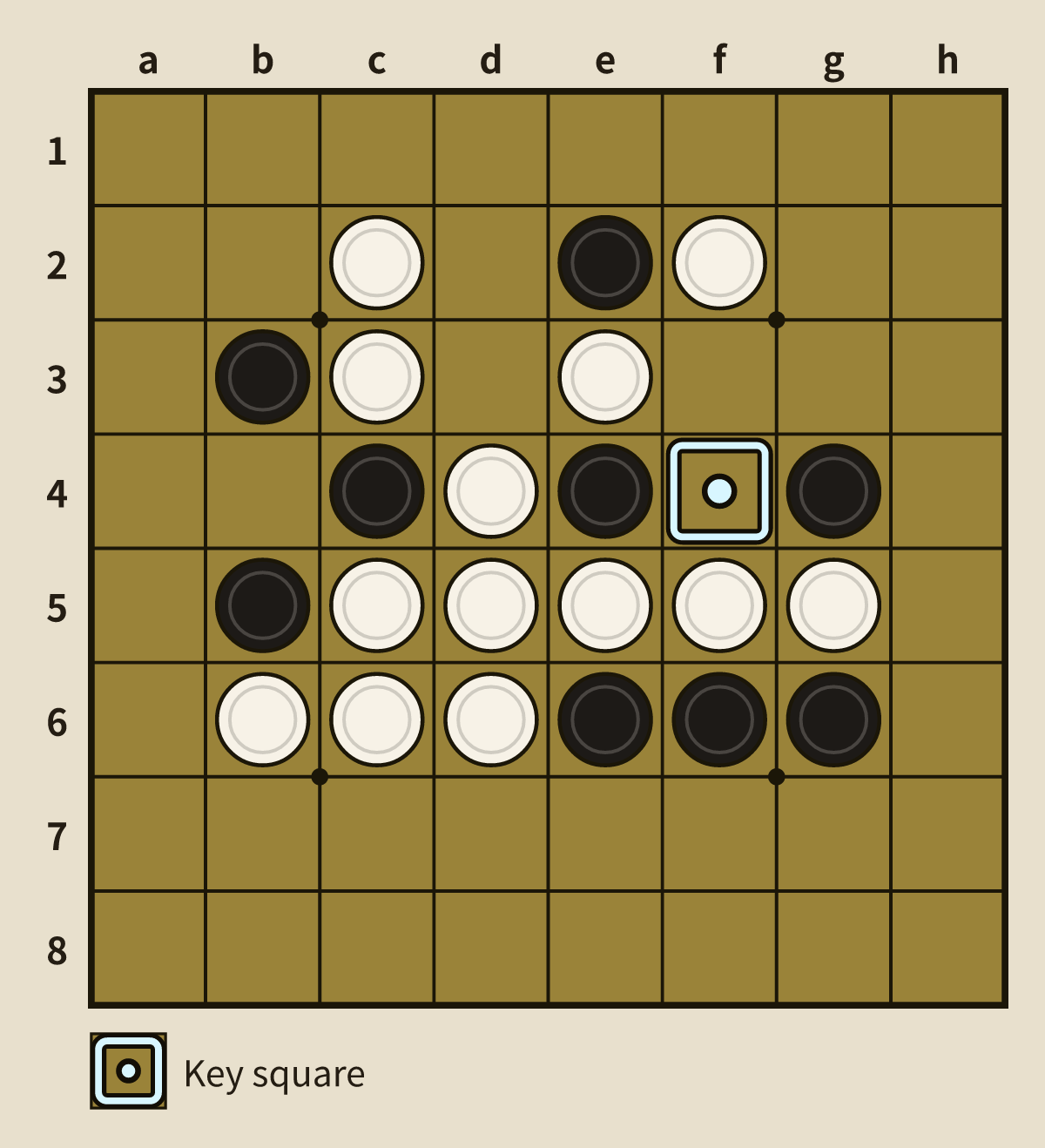
Figure 1 as text
Black discs (9): e2 b3 c4 e4 g4 b5 e6 f6 g6
White discs (13): c2 f2 c3 e3 d4 c5 d5 e5 f5 g5 b6 c6 d6
To move: Black
Key squares: f4
Board (from rank 1): ......../..W.BW../.BW.W.../..BWB.B./.BWWWWW./.WWWBBB./......../........
In this diagram, if Black plays f4, only 1 white disc at f5 is flipped. Because f5 becomes an interior disc surrounded on all 8 neighboring squares by discs after the move, it is a true quiet move. Black's discs touching empty squares increase by only 1, from 9 to 10, while White's available moves decrease from 18 to 14. In contrast, playing c7 to flip 2 discs at c6 and c5 leaves the flipped discs touching empty squares; Black's discs touching empty squares increase to 12, giving White 22 available moves. Even when flipping almost the same number of discs, where you flip them changes your opponent's options drastically.
| Item | Details |
|---|---|
| Objective | Deny available moves (mobility) to the opponent |
| Discs to Flip | Prioritize interior discs surrounded by other discs |
| Effect | Avoid forming frontier discs and prevent getting trapped |
| Try in App | Practice against the computer in Patent War |
In Reversi, the number of discs adjacent to empty squares is called openness. Making a move with high openness increases the squares on the board where your opponent can outflank discs, giving them greater freedom of action. Conversely, if you consistently stick to quiet moves with low openness that flip only interior discs, you narrow your opponent's options and can eventually force them into a situation where they must play into dangerous squares they would rather avoid.

Play in the app
The quickest way to learn an idea is to try it on the board. Your computer opponent thinks right on your device, so you can play every game against it to the end, anytime and anywhere.


Scan with your phone to open the store
Executing Quiet Moves in Real Games and Common Pitfalls
To successfully execute quiet moves in practice, do not be deceived by disc count. Pay close attention to the frontier line created after your move.
- List candidate moves: Look for squares among your legal moves that are close to the crowded center.
- Check openness of discs to flip: Check how many empty squares surround the outflanked discs. Prioritize interior discs not facing empty squares.
- Minimize flipped discs: Flipping many discs at once breaks your outer barrier; choose quiet moves that flip only 1 or 2 discs.
| Move Characteristic | Successful Example | Common Mistake |
|---|---|---|
| Number of flipped discs | Flip only 1 or 2 discs | Flip 4 to 5 or more at once |
| Position of flipped discs | Surrounded interior discs | Outer discs touching empty squares |
| Board after move | Own discs do not spread outward | Own discs form an outer wall |
| Result | Reduces opponent options on their turn | Gives opponent free choice of moves |
If your opponent uses quiet moves repeatedly and your own moves diminish, look for ways to pull their discs outward, or make a quiet reply to a low-openness square without forcing an attack. Inducing them to flip discs that create an outer wall will stop their chain of quiet moves.
Test these steps against the computer in Patent War. The computer features 50 difficulty levels from section 1 to section 50; intermediate levels offer challenging games aware of positional quality and mobility. Practice your tactical routine smoothly offline without any data connection.
Defending Against Quiet Moves and Endgame Strategies

To counter an opponent's quiet moves while securing victory, you need broad strategic vision spanning midgame quiet tesuji all the way to endgame parity.
Figure 2 as text
Black discs (11): e2 b3 c4 e4 f4 g4 b5 f5 e6 f6 g6
White discs (12): c2 f2 c3 e3 d4 c5 d5 e5 g5 b6 c6 d6
To move: White
Last move: f4
Board (from rank 1): ......../..W.BW../.BW.W.../..BWBBB./.BWWWBW./.WWWBBB./......../........
This diagram shows White's turn right after Black plays f4. White's available moves are now 14 squares: a2, a3, a4, a5, b4, d2, e1, e7, f3, f7, g3, g7, h4, and h6, down from 18 before Black's move. Moves d3, d7, f4, h3, and h7 are no longer playable, with only h4 newly added. Among the 14 squares, 7 are edge squares in the a-file, e1, and the h-file, while g7 is an X-square move diagonally adjacent to a corner. By using quiet moves to reduce inner squares, you force your opponent to pick squares near edges and corners.
| Tactic | Objective | Timing | Cautions |
|---|---|---|---|
| Quiet move | Maintain mobility and take away opponent moves | From opening transition into midgame | Requires interior discs to be possible |
| Wall creation (bad move) | Temporarily increase disc count | Common beginner mistake | Easily hands corners and good moves to opponent |
| Parity | Play the last move in a region | Endgame square cleanup | Fill odd regions before even regions |
After depriving your opponent of moves with midgame quiet moves, shift focus to endgame parity. When empty squares split into regions, playing first into an odd region and forcing your opponent to play first into an even region guarantees you the final move in each. Combining quiet moves with endgame theory leads to steady, reliable wins.
Frequently asked questions
What is the difference between a quiet move and simply flipping 1 disc?
It depends on whether the flipped disc is surrounded by others. Flipping 1 disc on an edge or outside is not a quiet move; only flipping an interior disc surrounded by no empty squares counts.
Can I focus on quiet moves starting right from the opening phase?
In the opening phase, the priority is to shape the center following a book opening. Once book opening moves place discs in the center, quiet moves become viable.
How can I practice quiet moves in an app?
Playing against the computer in Patent War is ideal. Intermediate levels evaluate positional value and mobility, letting you experience the power of quiet moves in realistic play.
What should I do if an opponent plays quiet moves first?
Respond calmly by choosing a square with minimal openness. Rather than taking many discs, wait for opportunities that drag your opponent's discs outward.
Play in the app
Patent War is a Reversi app set in a steampunk world. Computer matches and your journey are free to begin.
Scan with your phone to open the store