What Is Othello Evaluation? Understanding Numbers and Plus/Minus
Published
Conclusion: In Reversi, the evaluation value predicts the final disc difference if both sides play the best possible moves from that position. A score near 0 means an even game, while larger positive or negative numbers show a clearer advantage. Check whether your software measures relative to black or the current turn's player.

Analysis tools and computer match screens often show an evaluation number reflecting whether a board position is favorable. Understanding what these numbers mean helps you pinpoint which move changed the momentum.
Meaning of Evaluation Values and Standards for Assessing the Board
Evaluation values do not show current disc counts; they predict how many more discs the winning side will finish with under perfect play. A value of +4 predicts a 4-disc victory with optimal moves. In opening and midgame phases, it is an estimate, but in the solved endgame, it matches the exact final disc margin under optimal play.
| Item | How to Read the Value |
|---|---|
| What is evaluation? | Predicted final disc margin assuming both play optimal moves |
| Near 0 | Even position |
| Plus / Minus | Which side leads and by how many discs (depends on software) |
| Endgame complete readout | Exact final disc margin under best play, not an estimate |
| Patent War analysis | Reviews with accuracy, turning points, and 6 rating tiers rather than raw numbers |
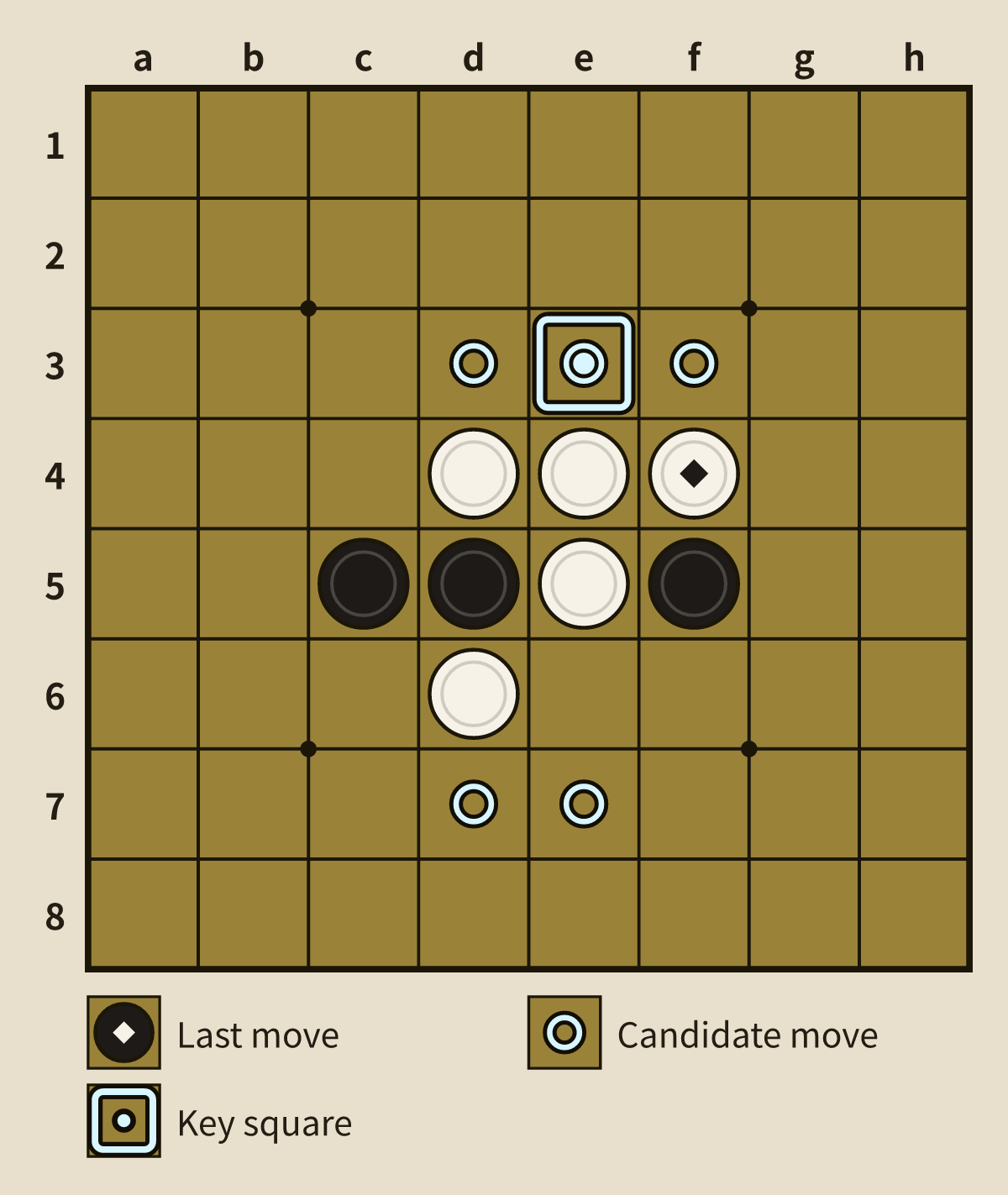
Figure 1 as text
Black discs (3): c5 d5 f5
White discs (5): d4 e4 f4 e5 d6
To move: Black
Last move: f4
Candidate moves: d3 d7 e3 e7 f3
Key squares: e3
Board (from rank 1): ......../......../......../...WWW../..BBWB../...W..../......../........
This board shows Black's turn during the Rabbit opening (f5 d6 c5 f4 e3). In the Rabbit, Black's next move is e3. In the opening phase, many options remain and evaluation gaps are smaller than in the endgame, making standard book openings the best route to build solid structure.
| Item | Key Focus |
|---|---|
| Opening phase focus | Follow book openings to choose moves with low openness and keep flipped discs inside. |
| Midgame focus | Restrict opponent moves and guide them into dangerous squares to take corners. |
| Endgame focus | Use parity to play the last move in each region, securing stable discs to win. |
| Practicing in-app | Test opponent move habits across difficulty levels in Patent War computer matches. |

Play in the app
The quickest way to learn an idea is to try it on the board. Your computer opponent thinks right on your device, so you can play every game against it to the end, anytime and anywhere.


Scan with your phone to open the store
Moves That Preserve Evaluation and Counters to Opponent Strategies
Preserving your evaluation means making careful square selections to deny corners while keeping options open for yourself. Avoiding dangerous squares directly stabilizes your win rate.
- In the opening phase, follow book opening blueprints and avoid flipping frontier discs touching empty squares.
- In the midgame edge battles, hand the turn back and avoid adding unnecessary exterior discs.
- Do not plunge into dangerous X-squares (b2, g2, b7, g7) or C-squares next to corners.
- Heading into the endgame, watch parity and take odd regions first to secure the final move.
Figure 2 as text
Black discs (5): e4 c5 d5 e5 f5
White discs (2): d4 d6
To move: White
Last move: c5
Candidate moves: f4 f6
Key squares: f4
Board (from rank 1): ......../......../......../...WB.../..BBBB../...W..../......../........
This diagram shows White's turn after move 3 c5 in the Rabbit opening. Standard Rabbit book play dictates White play f4. White can also play f6, but choosing a move that limits exterior expansion avoids corner risks and preserves future mobility for a stable midgame.
When an opponent tries to exhaust your mobility, returning the turn is effective. Instead of flipping many discs, a quiet move flipping only 1 disc restricts their options. Keeping focus on flipping interior discs will help keep your evaluation score safe from swings.
Try these techniques in computer matches in Patent War. Featuring 50 difficulty levels from Stage 1 to Stage 50, you can practice move patterns from beginner up to master rank. Because the computer calculates directly on your device, you can play offline while commuting.
8x8 and 6x6 Outcomes and Why Endgame Evaluations Lock In

A 2023 preprint paper calculated that an 8x8 board results in a draw when both sides play optimally. In theory, the starting position has an evaluation of 0. It is established that 8x8 games end in a draw under perfect play.
Figure 3 as text
Black discs (5): e3 d4 c5 d5 f5
White discs (4): e4 f4 e5 d6
To move: White
Last move: e3
Candidate moves: d3 f6
Board (from rank 1): ......../......../....B.../...BWW../..BBWB../...W..../......../........
This board shows White's turn in the Rabbit book opening after f5, d6, c5, f4, and e3. White has several playable choices like d3 and f6 to shape the midgame. Early on, focus on denying opponent mobility rather than obsessing over exact evaluation numbers.
To learn how to improve evaluation across the opening phase, midgame, and endgame, check out our guide on how to win at Reversi.
When few squares remain in the endgame, software computes all lines to the end, turning the evaluation into the exact final disc margin under optimal play. A sharp shift late in the game often signals a game-deciding move. Use parity to count empty squares in each region and secure the last move.
| Phase | Primary Factor | Beginner Misconception | Intermediate Judgment |
|---|---|---|---|
| Opening phase (moves 1–20) | Mobility and shape | Taking many discs gives an advantage | Keep disc counts low to widen options |
| Midgame (moves 21–40) | Positional value and restriction | Rush to claim edges | Force the opponent into risky squares |
| Endgame (moves 41–60) | Parity and stable discs | Taking corners guarantees safety | Count odd/even regions to play the final move |
| Situation | Successful Play | Common Mistake |
|---|---|---|
| Contesting areas around corners | Wait patiently until the opponent plays an X-square | Running out of moves and plunging into an X-square |
| Edge trades | Flip just 1 disc and pass the initiative | Taking entire edges at once, giving them a wall |
| Empty endgame regions | Play into odd regions first to control the finish | Enter even regions yourself and give up the turn |
Frequently asked questions
Why did I lose even though the evaluation was positive?
Evaluations assume optimal play from both players; subsequent bad moves change the outcome. Reviewing where the value dropped reveals the mistake that caused the defeat.
What does an evaluation of 0 mean?
It predicts a draw if both sides play optimally. A 2023 paper showed by computation that 8x8 boards result in a draw from the starting position under best play.
How can I build an intuitive sense of evaluations in the app?
Play computer matches in Patent War and use the match analysis feature to review critical turning points and move ratings. The engine reviews all moves on-device.
From whose perspective is the evaluation shown?
It depends on the software. Some display positive values for Black's advantage, while others show it from the current player's view. Check your tool's documentation.
Play in the app
Patent War is a steampunk Reversi app. You can start computer matches and your voyage for free.
Scan with your phone to open the store