Prevent Wipeouts in Othello! Midgame Traps & Endgame Logic
Published Updated

A "wipeout," where all discs on the board turn into one player's color to end the match, leaves a powerful impression on players. Many who have faced AI on a smartphone app and suffered a wipeout in othello have wondered how such an extreme outcome could occur.
While it might seem like a rare accident at first glance, the phenomenon of all discs becoming 1 color has a clear tactical explanation. Let us organize the fundamental ideas of the midgame, and see how to prevent extreme losses while taking control in the endgame.
The Mechanism of Wipeouts and Traps of the Opening Phase
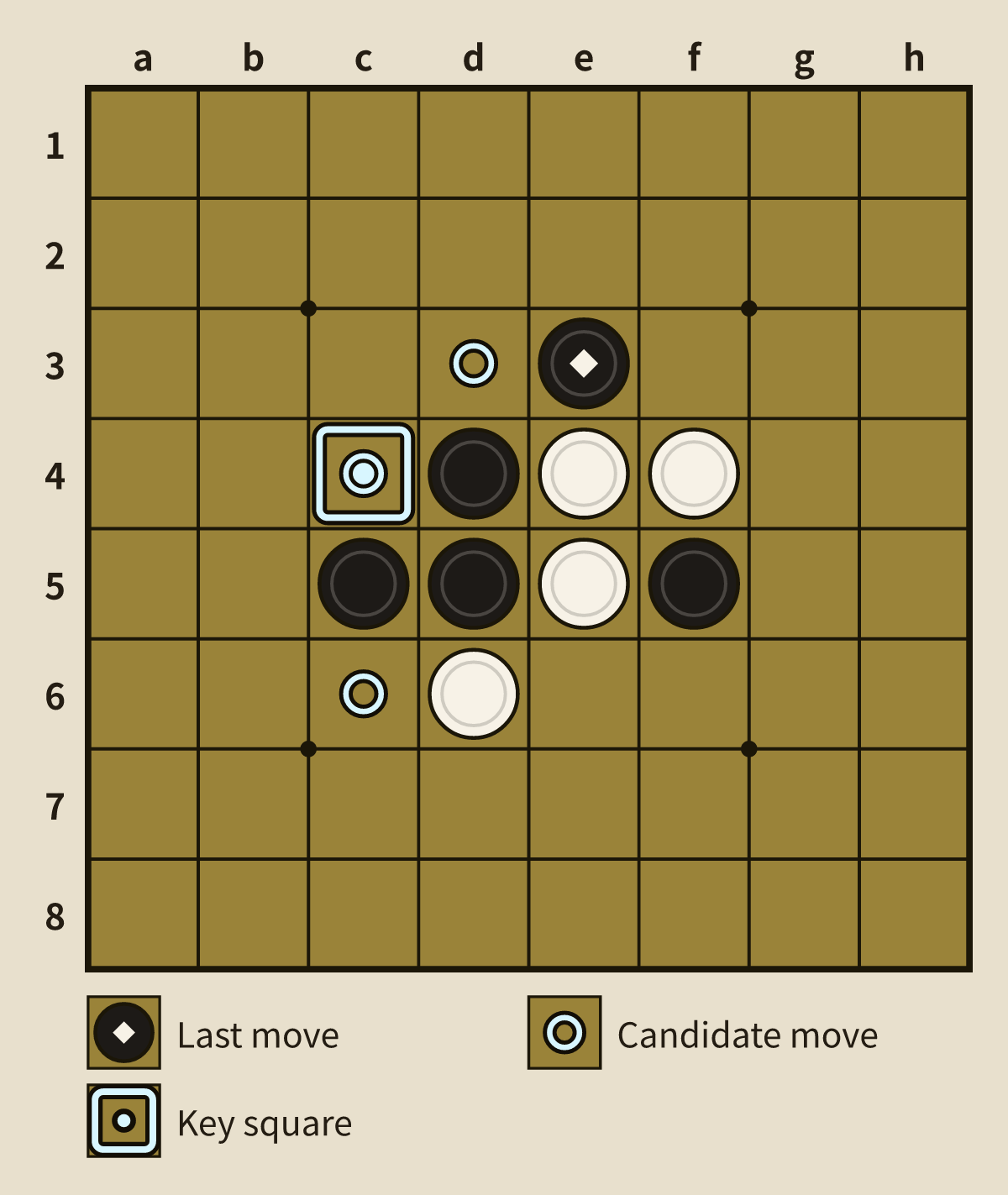
Figure 1 as text
Black discs (5): e3 d4 c5 d5 f5
White discs (4): e4 f4 e5 d6
To move: White
Last move: e3
Candidate moves: c4 c6 d3
Key squares: c4
Board (from rank 1): ......../......../....B.../...BWW../..BBWB../...W..../......../........
This diagram shows the board after Black played the first move f5 and followed the Rabbit book opening (f5 d6 c5 f4 e3). It is White's turn, with candidates like c4 and c6. The essential point in the opening phase is not to take many discs, but to limit the number of discs you flip and deny your opponent places to play.
Taking too many discs during the opening phase or midgame lines up your own color along the outside of the board. These are called "frontier discs." Creating frontier discs gives your opponent numerous move candidates, while you lose targets to outflank, rapidly shrinking your own playable squares.
A player with no playable squares is forced to pass. The opponent gets consecutive turns, and as your remaining discs are continuously outflanked and flipped, the board becomes a single color before all empty squares are filled, ending the match. This is the classic mechanism of a wipeout.

Play in the app
The quickest way to learn an idea is to try it on the board. Your computer opponent thinks right on your device, so you can play every game against it to the end, anytime and anywhere.


Scan with your phone to open the store
Board Analysis and the Art of Spotting Dangerous Moves
In Reversi research, the 36-square 6×6 board has been fully solved, and it is known that the second player wins when both sides play optimally. Meanwhile, exhaustive analysis of the standard 8×8 board has been pursued for many years, with advanced search techniques applied—such as a 2023 preprint showing that it ends in a draw.
Figure 2 as text
Black discs (4): d4 e4 e5 f5
White discs (6): b3 c3 d3 c4 d5 d6
To move: Black
Last move: b3
Risky squares: b2
Board (from rank 1): ......../......../.WWW..../..WBB.../...WBB../...W..../......../........
The diagram shows Black's turn. If Black thoughtlessly drops a disc on an X-square like b2 diagonally adjacent to a corner, it gives White an easy foothold to seize the a1 corner, which is extremely dangerous. A corner disc becomes an irreversible stable disc once taken. Carelessly making an X-square move in the midgame surrenders the corner and lets the opponent establish a base along the edge.
Surrendering a corner to your opponent in the midgame allows them to safely extend their discs from that anchor. As a result, your mobility is stripped away, greatly increasing the risk of being forced into a one-sided defeat such as a wipeout in othello.
| Dangerous move | Risk incurred | Basic remedy |
|---|---|---|
| Taking a large number of discs | Creates frontier discs, increasing opponent's mobility | Minimize flipped discs and play toward the interior |
| Careless X-square move | Opponent takes the corner and establishes a base | Do not play it until conditions prevent the corner loss |
| Venturing to the edge too early | Forced into unfavorable shapes | Prioritize contesting discs in the center |
Endgame Parity and the Path to a Decisive Victory

Figure 3 as text
Black discs (6): d3 e3 d4 e4 c5 e5
White discs (8): f4 d5 f5 c6 d6 e6 f6 d7
To move: Black
Last move: d7
Candidate moves: e7
Board (from rank 1): ......../......../...BB.../...BBW../..BWBW../..WWWW../...W..../........
In this position, empty squares remain separated across multiple regions, such as around e7 at the bottom of the board. The crucial guideline for endgame moves is "parity." When empty squares are divided into several regions in the endgame, the basic rule is to play first into an odd region so that you get to play the final move in that region.
Conversely, it is generally better not to enter an even region first. Entering an even region first allows the opponent to play the final empty square of that region, handing them stable discs. By playing into an odd region and taking the last move, you restrict your opponent's options and securely consolidate your advantage.
To practically master move counts and preserving mobility, experiencing AI tesuji in the smartphone app "Patent War" offers a direct shortcut to improvement.
Reversi is a delicate game where victory hangs in the balance until the final move. By mastering modest midgame moves and endgame parity, you can prevent unexpected defeats like wipeouts in othello and steadily pile up wins.
Frequently asked questions
What is the main cause of losing by a wipeout?
The main cause is taking too many discs in the opening phase or midgame, running out of playable squares. Creating frontier discs gives your opponent many move options, while leaving you with no discs to outflank, easily forcing passes.
Why is playing on an X-square dangerous?
It provides a direct foothold for your opponent to seize the corner. Once taken, a corner disc can never be flipped back, giving your opponent a permanent, stable base.
What is the concept of endgame parity?
It is the strategy of ensuring you play the last move in a region. Playing first into an odd region and letting the opponent enter an even region helps you maintain turn initiative and secure stable discs.
Play in the app
Experience the Reversi app Patent War, set in a steampunk world. Begin your journey and matches against the AI for free.
Scan with your phone to open the store