Othello Dan Ranks and Core Knowledge for Beating AI
Published Updated

When playing against AI in mobile apps, many intermediate players hit a wall and struggle to win consistently. In both Reversi as a general term and Othello as a trademarked game, ranks and grades often serve as benchmarks of strength. To reach a level comparable to a dan rank, moving beyond pure intuition and systematically understanding the tactical concepts and opening theory becomes essential.
The Origins of Reversi and Move Quality Across Ranks
Accounts differ regarding the history of Reversi, where players flip black and white discs on a board, but it is often said to trace back to a 19th-century English board game. Today, the format played across the world uses an 8x8 grid of 64 squares, starting with two black and two white discs placed diagonally in the center 4 squares, with black making the first move.
As players advance from beginner to intermediate and eventually to dan level, their thought process shifts dramatically. Beginners often focus solely on flipping as many discs as possible. Intermediate players begin to recognize the vital role of corners (the four corners), as a disc secured in a corner can never be flipped back, directly shaping the outcome. Advanced players intentionally capture fewer discs during the opening phase, aiming to restrict the opponent's mobility and force a pass.
| Skill Tier | Primary Focus | Key Challenge |
|---|---|---|
| Beginner | Flipping many discs | Losing corners easily |
| Intermediate | Securing corners and avoiding risks | Giving the opponent too many options |
| Dan equivalent | Controlling openness and options | Counting empty squares in the endgame |

Animal-Named Book Openings and Early Strategy
Decades of study in opening phase strategy have established standard sequences known as book openings. Interestingly, many of these book openings bear animal names such as Rabbit, Tiger, or Cow. While some say this arose because the disc arrangements resemble those animals, theories on their naming vary, having settled into standard usage through player community tradition.
- Rabbit: A classic book opening following "f5 d6 c5 f4 e3" from move 1. It offers solid balance, making it ideal for intermediate players learning the basics.
- Tiger: Progressing as "f5 d6 c3 d3 c4", this sequence creates dynamic pressure against white's responses in the center.
- Cow: Following "f5 f6 e6 f4 e3", this book opening focuses on building a solid center position before expanding the fight.
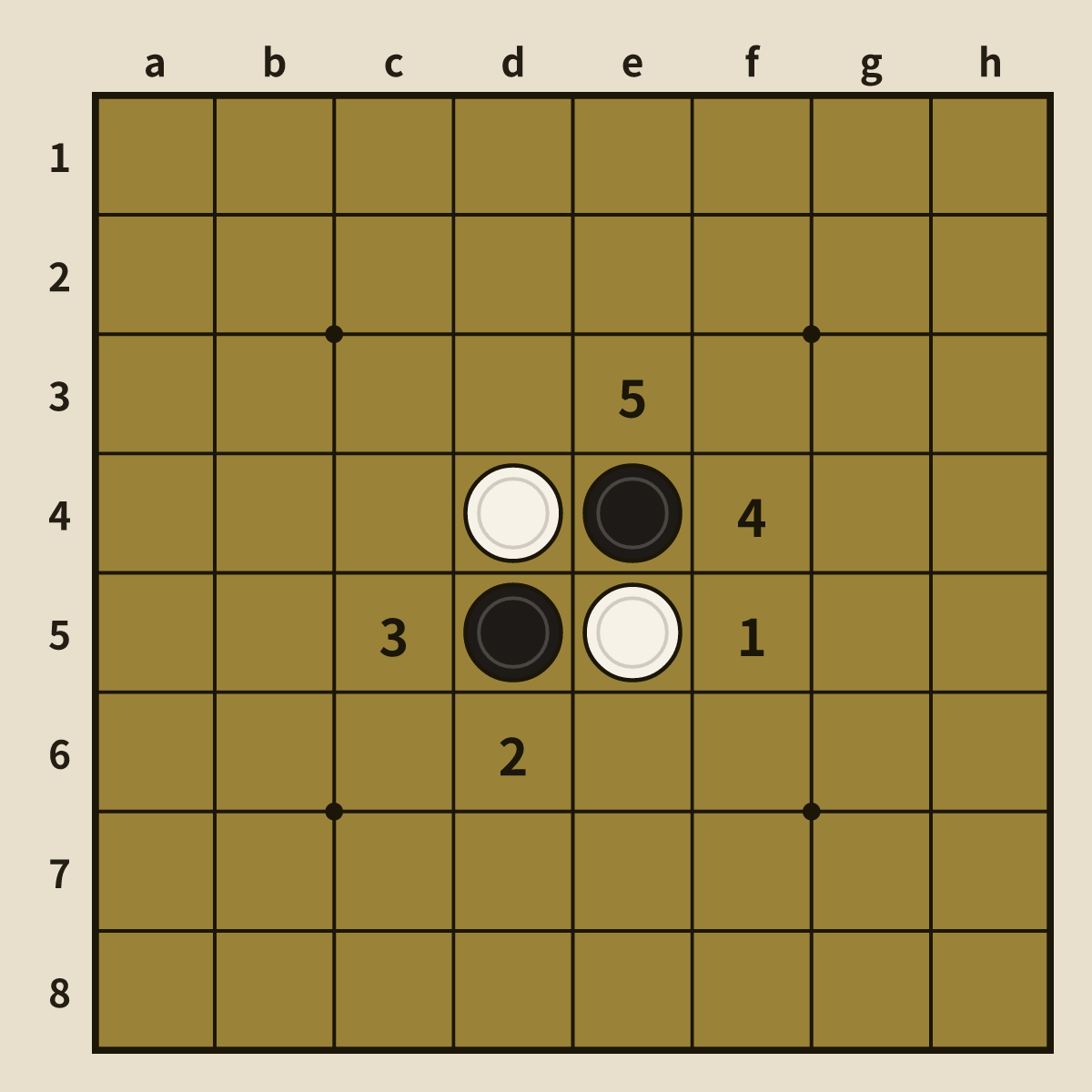
Figure 1 as text
Black discs (2): e4 d5
White discs (2): d4 e5
To move: Black
Move order: 1=f5, 2=d6, 3=c5, 4=f4, 5=e3
Board (from rank 1): ......../......../......../...WB.../...BW.../......../......../........
The numbers in the diagram indicate move order. From 1 at f5 to 5 at e3, Black and White take turns playing near the center.
The purpose of learning book openings is not mere memorization. Carelessly playing on an X-square adjacent to a corner diagonally, or a C-square bordering a corner on an edge, often hands the corner to your opponent. Book openings are structured to avoid these dangerous squares while maintaining low openness around flipped discs, preventing the opponent from finding advantageous moves.
Figure 2 as text
Black discs (6): c3 c4 d4 e4 e5 f5
White discs (3): d3 d5 d6
To move: White
Last move: c4
Candidate moves: b3 b5 f3 f4 g5 g6
Board (from rank 1): ......../......../..BW..../..BBB.../...WBB../...W..../......../........
The diagram shows the board advanced to move 5 at c4 following the second sequence listed above (f5 d6 c3 d3 c4). Black has 6 discs, White has 3 discs, and it is White's turn.
Play in the app
The quickest way to learn an idea is to try it on the board. Your computer opponent thinks right on your device, so you can play every game against it to the end, anytime and anywhere.


Scan with your phone to open the store
Controlling Discs and Mastering Parity in the Endgame
To progress beyond intermediate play, mastering parity in the endgame is crucial. As the game nears its conclusion, walls and stable discs partition the empty squares into distinct regions. Whether each region contains an odd or even number of empty squares dictates which player gains the advantage at the close.
The core rule of parity is to play into an odd region yourself, ensuring you get the final move in that region. Conversely, you should avoid initiating moves into an even region, compelling your opponent to play there first. Once the opponent enters, the remaining squares become an odd number, enabling you to claim the final square.
Playing the final move in a region often lets you flip substantial opponent discs while depriving them of subsequent options. Minimizing disc count in the opening phase to preserve mobility, followed by applying parity in the endgame to accumulate stable discs, represents the winning approach of expert players.
Sharpening Decision-Making Through AI Matches

To improve your win rate against AI, reviewing matches afterward is vital. An AI constantly evaluates the entire board to determine which squares are secure and which moves lead to loss of mobility. Build a habit of examining why a certain move created a disadvantage or when an opening was created that conceded a corner.
To hone your understanding of book openings and parity, practicing with mobile apps offering graduated AI levels, such as Patent War, is an excellent approach.
Observing AI play reveals that it takes surprisingly few discs in the opening phase, keeping its stones clustered in the interior. In the midgame, it gradually forces opponents onto C-squares and X-squares. By anticipating the AI's intent, avoiding hazards, and managing endgame empty squares, intermediate players can break through plateaus and approach dan-level strength.
Frequently asked questions
Are there rule differences between Othello and Reversi?
The core rules are identical, but the naming differs: Reversi is the generic term, whereas Othello is a registered trademark of MegaHouse.
Why is taking too many discs in the opening phase discouraged?
It prevents expanding your opponent's options. Flipping many discs early spreads your color outward, granting the opponent mobility while leaving you short of moves.
What is the core principle of parity?
It is an endgame technique to secure the final move in each region: enter odd regions first and let your opponent initiate play in even regions.
Why are X-squares and C-squares considered hazardous?
They frequently give the opponent an entry point to take corners. Because corner discs cannot be flipped, playing into adjacent X-squares or C-squares creates large disadvantages.
Play in the app
Patent War is a Reversi app set in a steampunk world. Begin your matches and adventure against AI for free.
Scan with your phone to open the store